


Memory athletes train by building a few mental systems and then practising them, most days, until they are fast and reliable. They are not born with special memories. They learn the memory palace, make an image for every number and card, and practise each championship event in its official format, checking every mistake. Thirty to sixty minutes a day is a normal amount.
Quick Answer: How Memory Athletes Train
- Build the systems: images for numbers and cards, and several memory palaces to hold them.
- Practise most days for 30 to 60 minutes: a little speed work, then one full timed event.
- Get it right before getting fast. Accuracy first, then push the speed a little at a time.
- Check every mistake and fix its cause, not just the answer.
- Run mock championships before a competition, so the full day feels normal.
What Is a Memory Athlete?
A memory athlete is someone who competes in memory championships. At a championship, people memorize as much as they can in a fixed time: a shuffled deck of cards, a page of random digits, a list of words, names and faces. Then they write it all down from memory. There are ten standard events, from five-minute Speed Cards to hour-long marathons.
The word "athlete" fits because the training looks like sport training. There is a clock, a score, a ranking, and a plan that gets harder week by week.
Are Memory Athletes Born or Made?
Made, according to the research. In 2003, scientists in London scanned the brains of a group of top memory competitors and compared them with ordinary people. The competitors were no different in intellect or in the structure of their brains. The difference was in how they used them: most said they used the method of loci, or memory palace, and their brains showed more activity in areas linked to places and routes.
A larger study in 2017 went one step further. It tested 23 memory athletes from the world's top 50, then trained people with ordinary memories in the memory palace method for 40 sessions of 30 minutes over six weeks. Before training, they recalled about 26 words out of a list of 72. After training, they recalled 62, and they kept much of that gain four months later. People who did other kinds of brain training instead showed no such change (see do memory games improve memory?).
Step 1: Build the Systems
Before speed, memory athletes build tools. Each tool is prepared in advance, so on the day there is nothing to invent. Most athletes use four:
| System | What it is and where it is used |
|---|---|
| Number system | An image for every pair (or triple) of digits, so a long number becomes a row of pictures. Used for Speed, Hour, Spoken and Binary Numbers, and for the years in Historic Dates. |
| Card system | An image for every card, or for every pair of cards. Used for Speed Cards and Hour Cards. |
| Memory palaces | Familiar routes with fixed stops, where the images are placed in order. Every event that needs order uses them. |
| Quick images | The habit of turning any word, name or shape into a clear picture in a second or two. Used for Random Words, Names and Faces and Abstract Images. |
The number system is the biggest job. A two-digit system needs 100 images (00 to 99). A three-digit system needs 1,000. A common path is to start with the Major System and later move to a PAO system (Person-Action-Object), which packs more digits into each picture. If you are choosing, read PAO vs the Major System.
You can build your lists with the free Major System generator and the PAO builder. Learn them a small group at a time: ten new images a day is plenty.
Step 2: Build Many Memory Palaces
A memory palace is a route you know well, such as your home or your street, with fixed stops along it. You place one, two or three images at each stop, then walk the route in your mind to recall them in order.
Beginners need one palace. Athletes need many, because a long event fills a lot of stops and the same palace cannot be used twice in one day without mixing up old and new images.
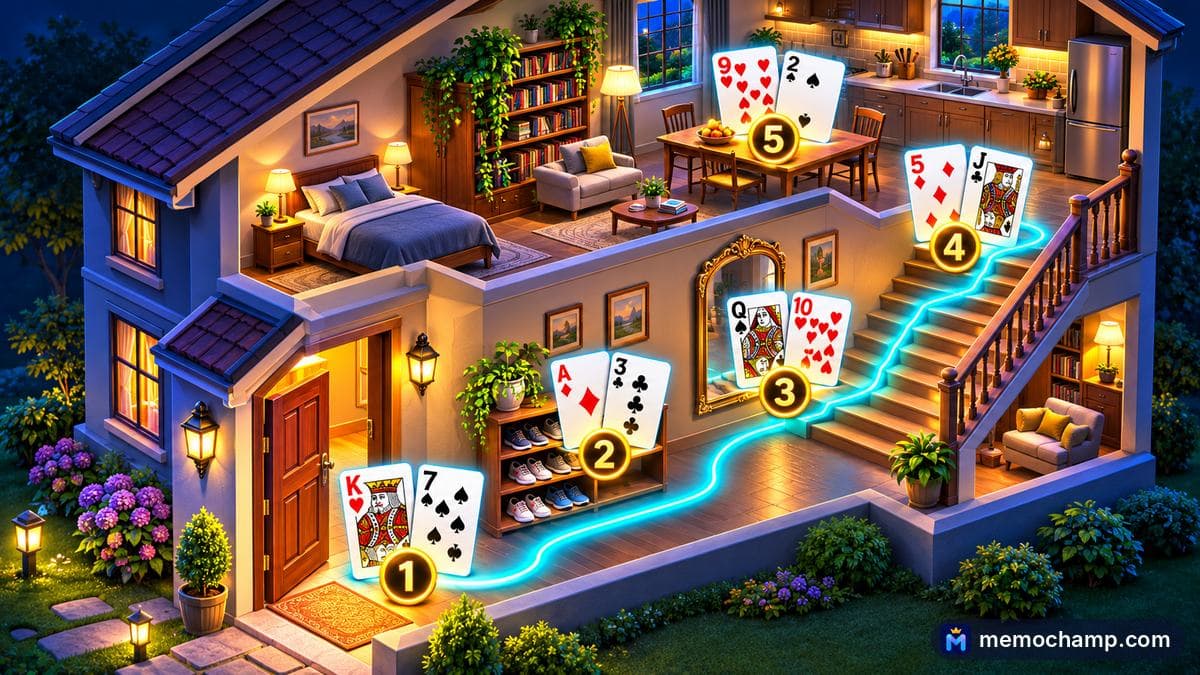
Plan your routes and their stops with the free Palace Builder, or copy a route from the memory palace examples. For how many palaces each event takes, see how many memory palaces you need.
Step 3: Practise a Little, Most Days
Top athletes train less than you might think. Alex Mullen, a three-time World Memory Champion, has written that he trains about 30 minutes a day on average, more before a big championship. He spends about a quarter of that time on speed work and the rest on full competition events, and he likes to train in the morning.
A session of about 35 minutes can follow the same shape:
| Part | What to do |
|---|---|
| Warm-up · 5 min | Run through your number or card images as fast as you can, just seeing each picture. No palace, no recall. |
| Main event · 20 min | One event in its official format: timed memorizing, then full recall on a separate sheet. |
| Check · 5 min | Mark every mistake and write down why it happened: a weak image, a blurry stop, or going too fast. |
| Upkeep · 5 min | Fix the images that failed, and walk one memory palace in your head from start to end. |
Short daily sessions work better than one long session a week. They keep your images fresh, and they give your memory the spaced practice it needs (see spaced repetition).
Step 4: Accuracy First, Then Speed
In most events, mistakes cost more than slowness. In Speed Numbers, for example, one wrong digit in a row costs half the row's points, and a second costs all of them. So athletes first get a short set right every time, and only then try to go faster.
Once a skill feels easy, most people stop getting better. The journalist Joshua Foer, who won the 2006 USA Memory Championship after a year of training, called this the "OK plateau" in his book Moonwalking with Einstein. The way out, which he learned from the psychologist Anders Ericsson, is deliberate practice: push a little faster than is comfortable, expect some mistakes, and study each one.
- Time everything. If you do not know your pace, you cannot raise it. The pace calculator turns a target score into seconds per image.
- Raise the target in small steps. A few seconds faster per deck, or one more row of digits.
- Drop back when accuracy falls. Go back to the last pace you could recall perfectly, then try again.
If you are stuck, the guide to getting moving again has more ways out.
Step 5: Check Every Mistake
After each attempt, athletes look at what went wrong and why. The cause is usually one of a small number of things:
- A weak image. The same number or card fails again and again. Replace its image with something clearer or funnier.
- A weak stop. Images vanish at the same place in a palace. Move the stop or make it more distinct.
- Two similar images. Two pictures that look alike get swapped. Change one of them.
- Rushing. Errors pile up near the end. Slow your pace slightly.
On MemoChamp, every finished attempt is kept in your history. For the number and card events, each event's progress page also shows your weak spots: the images and the palace stops that fail most often.
Step 6: Cover Every Event in a Week
A championship has ten events, so athletes rotate through them. A typical week trains each family of events at least once and keeps one day for something longer:
| Day | Focus |
|---|---|
| Monday | Numbers: Speed Numbers, plus a short Spoken Numbers run |
| Tuesday | Cards: Speed Cards, two or three decks |
| Wednesday | Words and dates: Random Words and Historic Dates |
| Thursday | Faces and images: Names and Faces and Abstract Images |
| Friday | Binary Numbers, plus your weakest event of the week |
| Saturday | One long event (Hour Numbers or Hour Cards), or a mock championship |
| Sunday | Rest, or light review of your images and palaces |
Change the plan to suit your goals: spend more time on the events where you have the most points to gain. For a fuller version, read how to structure a week of memory training, or follow one of the free training plans.
Step 7: Rehearse the Whole Championship
A full championship lasts a day or more. Recall periods are long, and the hour events need focus for a long time. So in the weeks before a competition, athletes run complete mock championships: every event, in order, with official times and breaks.
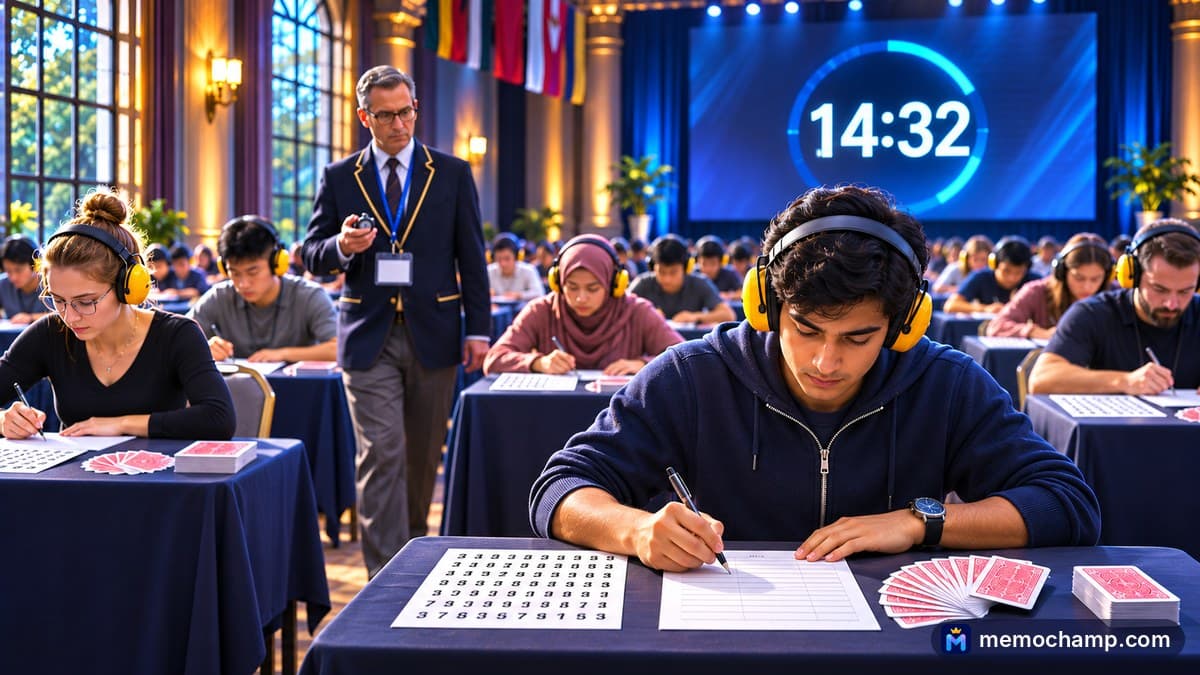
- Run a mock championship online, with each event in its official format.
- Or print a training sheet and its recall sheet, so you practise with pen and paper, as on the day.
- Train the long events on their own as well. See how to train for the hour events.
In the last week before a competition, train less and keep everything familiar. This is not the time for new images or new palaces. The first competition guide has a checklist for the day.
Step 8: Measure Progress in Championship Points
Raw scores are hard to compare across events: 52 cards in a minute and 400 digits in five minutes are very different things. Championships solve this with a points scale. Each event has a Millennium Standard, and reaching it is worth 1,000 points.
Athletes use the points to see which events pull their total down, and train those first. Work out yours with the championship points calculator, and see the top results in each event on the world records page.
Step 9: Sleep, Rest and Staying Calm
Memory training is tiring, and a tired mind makes blurry images. Alex Mullen aims for at least seven and a half hours of sleep. Take a day off each week as well, and practise staying calm under the clock: nerves on the day can cost more points than any weak image.
Common Mistakes When Training Like a Memory Athlete
- Starting with speed. Fast and wrong scores less than slow and right.
- Building a huge system before using it. Start practising with the images you have, and grow the system as you go.
- Training only your favourite event. The overall ranking adds up all ten.
- Never practising recall. Memorizing without writing it back down teaches you very little.
- Reusing a palace too soon. Old images get in the way. Give each palace time to clear.
How to Start Training Like a Memory Athlete Today
- Take the free assessment, or a few memory tests, so you know where you start.
- If you are new to techniques, follow memory training for beginners first: four weeks, fifteen minutes a day.
- Pick one event to begin with. Which event to start with compares all ten.
- Practise it in its official format, starting low on its level ladder: Speed Cards, Speed Numbers, Random Words or any of the ten championship events.
- When you feel ready, test yourself against other people in Compete, or find a real event near you.
Frequently Asked Questions
How do memory athletes train?
They build mental systems first: a set of images for numbers and cards, and many memory palaces to store them in. Then they practise most days, usually 30 to 60 minutes, mixing short speed work with full timed events, checking every mistake, and running mock championships before a competition.
How many hours a day do memory athletes train?
Less than most people expect. Three-time World Memory Champion Alex Mullen has written that he trains about 30 minutes a day on average, more before a championship. Regular short sessions matter more than long ones.
Are memory athletes born with a better memory?
The research says mostly no. A 2003 brain-imaging study found that leading memory competitors did not have better intellect or differently built brains than other people. What they had was a learned method: most of them used a memory palace.
Can anyone train like a memory athlete?
Yes. In a 2017 study, people with ordinary memories trained the memory palace method for 30 minutes a day over six weeks. On average they went from recalling 26 words out of 72 to 62, and much of the gain was still there four months later.
How long does it take to become a memory athlete?
You can enter your first competition after a few months of regular practice. Reaching a high national or international level usually takes years, because each system has to become fast enough to work almost without thinking.
What techniques do memory champions use?
The memory palace (method of loci) for order, plus a fixed image system for numbers and one for cards, such as the Major System or a Person-Action-Object system. Names, words, dates and abstract images use vivid images linked to the right place or face.
Do memory athletes forget things like everyone else?
Yes. Their techniques work on material they choose to memorize with effort. Keys, appointments and everyday details still slip unless they use a method on them, and practice material is usually allowed to fade.
Core Takeaways
- Memory athletes are made by method and practice, not born with special brains.
- They build systems first: images for numbers and cards, and many memory palaces.
- They practise most days, often about 30 minutes, with full timed events and a check of every mistake.
- They get accurate first, then raise their speed a little at a time.
- They rehearse the whole championship before the real one.
Related Guides
- What memory championships are — the ten events, scoring and rankings.
- Memory Techniques — every method, and which to use when.
- How to Memorize a Deck of Cards — the card system, step by step.
- How to Memorize Numbers — from your first number system to a full sheet.
Sources
Read on 2 November 2026: Maguire, Valentine, Wilding and Kapur, "Routes to remembering: the brains behind superior memory", Nature Neuroscience (2003); Dresler et al., "Mnemonic training reshapes brain networks to support superior memory", Neuron (2017), with the word counts from the study's press release; Alex Mullen, Memory Sports FAQ; Joshua Foer, Moonwalking with Einstein (2011).
Get new memory guides by email
New guides and practical memory-training tips, now and then. Unsubscribe at any time.
We'll only use your email for this list. See the privacy policy.