The Method of Loci — better known as the memory palace technique — is the oldest documented memory system in the Western tradition, and it's still the one nearly every serious memory athlete builds everything else on top of. It works by attaching what you want to remember to places you already know, in a fixed order, so that recalling the list becomes as simple as mentally walking a route you can't forget.
This article covers what the method actually is, why it works, and — the part most explanations skip — exactly how to do it, with a full worked example you can follow the first time you try.
What Is the Method of Loci?
The Method of Loci is a mnemonic technique that uses spatial memory — your memory for places and layouts — to store and retrieve an ordered sequence of information. Instead of memorizing a list of items directly, you imagine walking through a place you know well, and at each stop along the way you "place" a vivid mental image representing one item. To recall the list, you walk the same route again in your mind, and each stop hands you back its image, and the image hands you back the item.
It isn't a trick for a specific kind of content — numbers, words, and images can all be encoded this way — and it isn't limited to a fixed size. The technique scales from a five-item errand list to the tens of thousands of digits and cards elite memory athletes recall in competition, using the same basic mechanism at every scale.
What Does "Loci" Mean?
Loci is the Latin plural of locus, meaning "place" or "location." A single stopping point on your route — the doormat, a specific chair, the kitchen sink — is one locus; the full set of stopping points you use is your loci. The Latin terminology has stuck around since the technique's origin in classical Roman rhetoric, where it was taught to orators as a way to memorize speeches point by point.
Method of Loci vs. Memory Palace
These two terms refer to the same technique and are used interchangeably, including throughout this article — "memory palace" is simply the popular, modern name for the Method of Loci, the older academic and historical term. "Memory palace" gained wider recognition through Sherlock Holmes's "mind palace," but the underlying method predates that by roughly two thousand years. One small distinction some writers draw: "palace" is sometimes used loosely for any familiar structure, while "loci" more precisely refers to the individual stopping points within it — in practice, nobody enforces this distinction strictly.
How the Method of Loci Works
Strip away the terminology and the method has four moving parts:
- A route through a place you already know cold, walked in a fixed, unchanging direction.
- A series of distinct loci — specific stopping points — spaced along that route.
- A vivid mental image representing each piece of information, placed at one locus each, in order.
- A mental walkthrough of the same route to retrieve the images, and with them, the information.
None of this requires the place to be physically in front of you while you use it — you're working from a mental model of it. What it does require is that the model be genuinely familiar, so recalling the route itself takes no effort, leaving all your attention free for the images.
Why Does the Method of Loci Help With Memory?
A few things are doing real work here, and it's worth being precise about which ones are established versus plausible.
Spatial memory is a strong, well-practiced system. You can likely describe your childhood bedroom, or navigate your commute on autopilot, without ever having deliberately "studied" either — spatial layouts are something the brain encodes efficiently by default. Brain-imaging research on elite memory athletes found they rely heavily on this system: their advantage over controls wasn't higher intelligence or unusual brain anatomy, but greater engagement of hippocampal and other spatial-memory regions while encoding, consistent with a spatial strategy doing genuine cognitive work rather than just being a mnemonic gimmick (Maguire et al., 2003).
Order comes for free. In a plain list, remembering the sequence is a separate task from remembering the content. In a memory palace, the sequence is the sequence of loci — something you already know without trying — so you're never separately holding "this was item seven" in mind. You just arrive at the seventh stop.
Vivid images create richer memory traces than words alone. This is really the domain of visualization as a skill in its own right — the palace is a structure for organizing images, but the images are what carry the actual information. A weak image placed at a strong locus is still a weak memory.
What the method does not do, as far as current evidence shows: it doesn't raise IQ, doesn't permanently restructure the brain in a general sense, and doesn't guarantee anything will stay in long-term memory without review. More on the evidence itself later in this article.
How to Use the Method of Loci, Step by Step
Step 1: Choose a Familiar Place
Pick somewhere you can picture in detail without effort — your home, your childhood house, your commute, your workplace. Familiarity matters more than size or grandeur; a small apartment you know perfectly beats an impressive building you've only visited once.
Step 2: Create a Fixed Route
Decide on one direction of travel through the place and commit to it — always front door to back, always clockwise around the room, never reversed. A route you sometimes walk forward and sometimes backward will scramble your recall order.
Step 3: Choose Your Loci
Mark specific, distinct stopping points along the route: the doormat, the shoe rack, the hallway mirror, the kitchen table. Each locus should be a clearly separate spot you could point to without hesitating — not "somewhere in the living room," but "the left arm of the couch." Beginners generally do best starting with 5–10 loci in one small area, then expanding once the technique feels comfortable — there's no fixed scientific capacity limit here, it's simply easier to learn the skill on a small, manageable set first.
Step 4: Create Vivid Mental Images
For each item you want to remember, invent one image that represents it — and make that image work harder than a plain mental snapshot. The principles that make an image stick: exaggerated size, motion, color, emotion, absurdity, multiple senses, and direct interaction with the locus itself rather than just sitting near it.
Step 5: Associate Information With Each Locus
Place one image at each locus, in order, matching the order of your list. If you have more items than loci, don't stack unrelated images at a single stop — combine them into one composite scene instead, which is exactly what the PAO System is built for.
Step 6: Walk Through Your Memory Palace
Before trying to recall anything, mentally walk the route once, locus by locus, confirming each image is where you left it. This single pass is often where a shaky image reveals itself — if you can't quite "see" what's at a stop, strengthen that image before moving on.
Step 7: Practice Retrieval
Recall isn't automatic just because encoding worked — it needs its own active recall practice. Walk the route again later, then the next day, and try to state each item from memory before checking. This retrieval step is what turns a one-time trick into something you can actually rely on.
A Complete Example: Memorizing a Shopping List
Here's the full technique applied to a 10-item shopping list, using a home as the palace. The route: front door → shoe rack → hallway mirror → staircase → kitchen table → refrigerator → sink → dining chair → bookshelf → bedroom door.
- 1Front door
- 2Shoe rack
- 3Hallway mirror
- 4Staircase
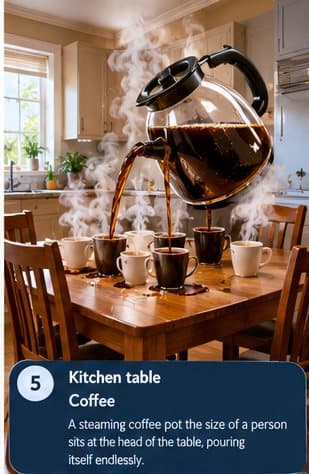
- 5Kitchen table
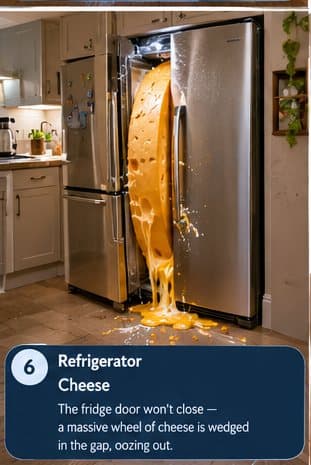
- 6Refrigerator
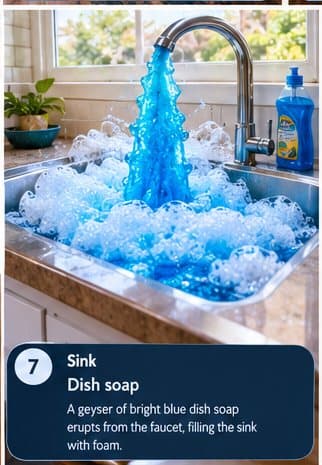
- 7Sink
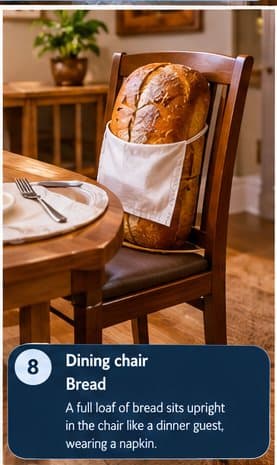
- 8Dining chair
- 9Bookshelf
- 10Bedroom door
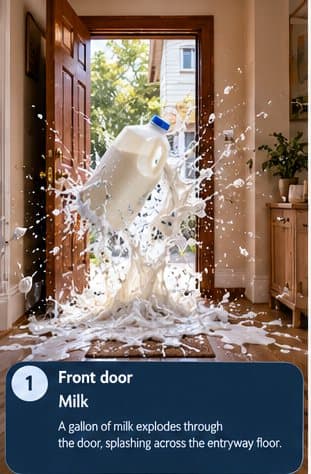
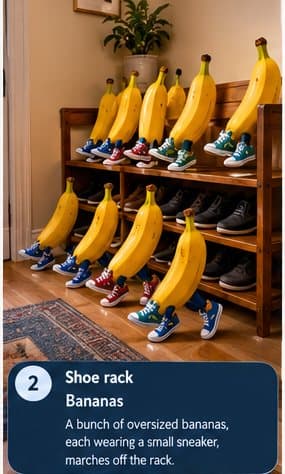
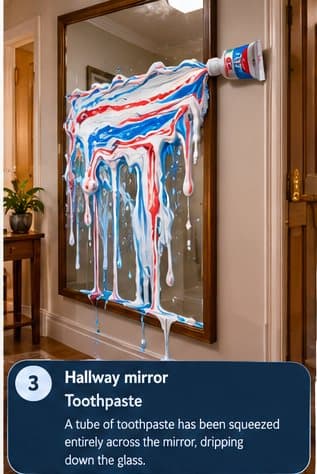
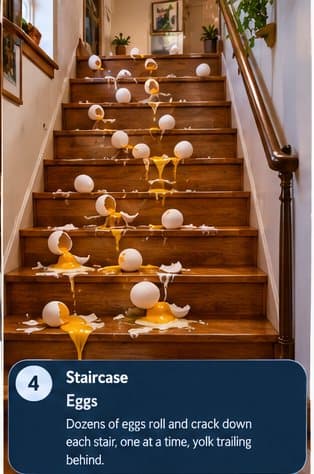
| Locus | Item | Mental image |
|---|---|---|
| Front door | Milk | A gallon of milk explodes through the door, splashing across the entryway floor. |
| Shoe rack | Bananas | A bunch of oversized bananas, each wearing a small sneaker, marches off the rack. |
| Hallway mirror | Toothpaste | A tube of toothpaste has been squeezed entirely across the mirror, dripping down the glass. |
| Staircase | Eggs | Dozens of eggs roll and crack down each stair, one at a time, yolk trailing behind. |
| Kitchen table | Coffee | A steaming coffee pot the size of a person sits at the head of the table, pouring itself endlessly. |
| Refrigerator | Cheese | The fridge door won't close — a massive wheel of cheese is wedged in the gap, oozing out. |
| Sink | Dish soap | A geyser of bright blue dish soap erupts from the faucet, filling the sink with foam. |
| Dining chair | Bread | A full loaf of bread sits upright in the chair like a dinner guest, wearing a napkin. |
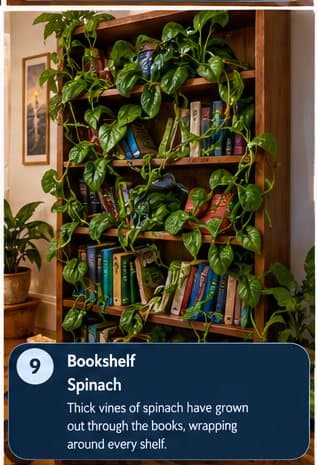
| Bookshelf | Spinach | Thick vines of spinach have grown out through the books, wrapping around every shelf. |
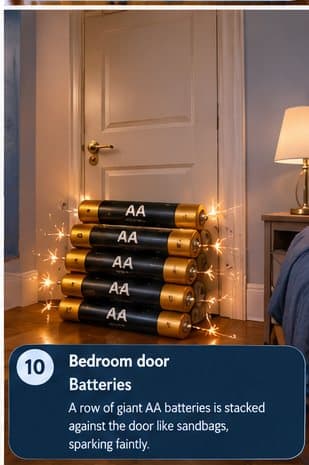
| Bedroom door | Batteries | A row of giant AA batteries is stacked against the door like sandbags, sparking faintly. |
Notice what each image is doing: none of them just sit passively "near" their locus. The milk isn't beside the door, it's crashing through it. The toothpaste isn't on the counter, it's smeared across the mirror people actually look at every day. Every image physically interacts with, damages, or transforms the specific spot it's placed at — that interaction is what makes the pairing memorable rather than arbitrary.
To recall the list, you walk the route in your head exactly as built: front door (milk), shoe rack (bananas), mirror (toothpaste), staircase (eggs), and so on. Each locus is a retrieval cue that was never in doubt — you know your own house — and each image, because it's vivid and specific, comes back with it. This is the whole mechanism, just compressed into ten steps: familiar structure supplies the order, vivid images supply the content.
Building a Memory Palace That Doesn't Fall Apart
A few structural habits separate palaces that hold up from ones that collapse into confusion:
- Keep loci distinct and well-spaced. Two stopping points that are too close or too similar blur together on recall. A useful test: could you point to each locus individually, without hesitating, if asked cold?
- Never let the route cross itself. A path that loops back through an earlier area makes it easy to lose track of which pass you're on.
- Keep separate lists in separate palaces. Reusing the same palace for two different lists without clearing it first is the single most common cause of "ghost" images — old information bleeding into new recall attempts.
- Rehearse the empty route before you ever use it for real. Walk a brand-new palace once with nothing placed in it yet, just to confirm you can navigate it smoothly.
- Start small and grow deliberately. Five to ten loci is enough to learn the mechanics. Competitive memory athletes maintain dozens to hundreds of palaces, each rehearsed until the route is automatic — but that's a product of extended practice, not a starting requirement.
What Makes a Mental Image Actually Stick
The single biggest reason a memory palace "doesn't work" for someone isn't the palace — it's weak images. Compare these two:
A giant apple is sitting beside the front door.
A gigantic apple crashes through the front door, splintering the wood.
The first is a mental photograph — static, generic, and forgettable, because nothing about it is distinct from any other object you might have placed "beside the door." The second gives you motion, cause and effect, sound, scale, and destruction — several independent details your brain has more to grab onto, and a scene that couldn't be confused with anything else in the palace. On recall, "what's happening at the front door" retrieves a specific event far more reliably than "what's near the front door" retrieves a static object.
The reusable checklist for building images like the second one:
- Exaggerate scale — not a car, a car the size of a house.
- Add motion — melting, exploding, crashing, growing, not sitting still.
- Make it interact with the locus, not just occupy space near it.
- Bring in other senses — sound, smell, texture, temperature.
- Lean into emotion or absurdity — embarrassing, funny, or unsettling images outlast neutral ones.
This is really the domain of visualization as a distinct, trainable skill — worth practicing on its own if palace recall feels inconsistent.
Common Method of Loci Mistakes
- Using static, "beside it" images instead of active ones that interact with the locus.
- Loci packed too close together, so recall blurs one stop into the next.
- Reusing a palace without clearing it, leaving old images to interfere with new ones.
- Skipping retrieval practice — encoding a palace once and assuming it will hold without ever testing recall.
- Starting too big — a 50-locus palace before the basic mechanics are comfortable usually just produces 50 weak images instead of ten strong ones.
Using the Method of Loci for Studying
The technique is well suited to anything that can be broken into an ordered sequence of concrete or imageable chunks — and less suited to building deep conceptual understanding, which it was never meant to replace.
Vocabulary
Convert each foreign word into an image — often by sound-alike association with a word in your own language — and place it at a locus alongside an image for its meaning. See How to Memorize a List of Words for the word-specific mechanics.
History and Dates
Turn a date or a sequence of events into images and walk them through a palace in chronological order — the palace supplies the ordering that a bare timeline otherwise asks you to hold in your head. See How to Memorize Dates.
Science
Ordered processes — the steps of a biochemical pathway, the stages of mitosis, an anatomical sequence — map naturally onto loci in the order they occur. This is exactly the setup used in a classroom study where medical students taught endocrinology via the method of loci outscored a self-directed-study comparison group on assessment (Qureshi et al., 2014).
Presentations and Speeches
This is the technique's original use case — Roman orators walked a mental building to recall speeches point by point without notes. Each locus holds one talking point or transition, in the order you'll deliver them.
Numbers and Playing Cards
Raw digits and cards aren't naturally imageable, so they're first converted into images using the Major System (for numbers) or a dedicated card system, then placed at loci exactly like any other item — see How to Memorize Numbers and How to Memorize a Deck of Cards.
What the technique won't do: replace actually understanding why something is true, or substitute for repetition and spaced review once information is encoded. It's a way to get information into a retrievable order quickly — not a shortcut around learning.
The Method of Loci in Competitive Memory
This is the technique underneath nearly every event at the World Memory Championships — Random Numbers, Random/Speed Cards, Random Words, Historic Dates, and more all rely on converting raw information into images and walking them through prepared palaces. Competitive athletes don't build a palace on the fly; they maintain a large personal library of pre-rehearsed palaces, often dozens to hundreds, each with a route so automatic it requires no conscious navigation, and chain several together end to end for the longest events. Brain-imaging comparisons between these athletes and matched controls found no advantage in general intelligence or brain structure — the measurable difference was in how heavily they engaged spatial-memory regions while encoding, consistent with practiced use of this specific strategy rather than an innate gift (Maguire et al., 2003).
Combining It With Other Techniques
The Method of Loci is rarely used alone at any serious level — it's a structure, and other systems supply what actually goes into that structure.
+ Major System
Numbers aren't naturally imageable, so the Major System converts each pair of digits into a consonant-sound word first. The full chain looks like: number → word → image → locus. A digit string becomes a sequence of words, each word becomes a vivid image, and each image gets placed at the next stop on the route.
+ PAO System
For denser encoding, the PAO System compresses three numbers (or cards) into a single Person-Action-Object scene, so one locus can hold what would otherwise take three. This is the standard approach for high-volume events like Random Numbers and Speed Cards, where minimizing loci needed per unit of data directly increases how much fits in the time limit.
+ Linking Method
For a short list you'll only use once, building a full palace can be more setup than the task deserves. The Linking Method chains items directly to each other with no palace required — faster to start, but more fragile, since losing one link in the chain breaks everything after it. A memory palace doesn't have this weakness: lose one locus, and every other locus is still anchored independently. Reach for the Linking Method on short, disposable lists, and the Method of Loci for anything long, ordered, or worth keeping.
Does the Method of Loci Actually Work?
What the research shows
The evidence for the core technique is genuinely good, by the standards of cognitive psychology. A 2021 meta-analysis pooling 13 randomized controlled trials found a medium-sized benefit over no-strategy conditions (Hedges' g = 0.65) that held up under sensitivity checks for publication bias (Twomey & Kroneisen, 2021). A broader 2025 systematic review found a large effect specifically on immediate serial recall compared with rote rehearsal (d = 0.88), and traced the benefit to established encoding mechanisms plus consistent activity in hippocampal and parahippocampal regions during use (Ondřej et al., 2025). Training studies with novices — not just elite athletes — found that a few weeks of practice produced large, measurable recall gains that persisted months later (Dresler et al., 2017), and that the effect isn't tied to a lifetime of familiarity with a location: a briefly-learned virtual environment worked about as well as a real one (Legge et al., 2012).
Effect size vs. no strategy or rote rehearsal
Higher = larger benefit in the pooled studies. Whiskers show the 95% CI.
Limits of the evidence
Nearly all of this evidence comes from controlled lab tasks — usually recalling a list of unrelated words — rather than real-world outcomes like exam performance over a semester. Individual trials tend to have small samples, and long-term follow-up beyond a few months is rare. The comparisons are typically against no strategy at all or plain rehearsal, not against other well-supported study methods like spaced retrieval practice, so "better than doing nothing" is a fair summary, not "better than everything else." None of this evidence supports claims about increased intelligence, permanent brain rewiring, or guaranteed retention — the technique reliably helps you encode and briefly retain ordered information; it doesn't do the reviewing for you.
Advantages and Limitations, at a Glance
Where it genuinely helps: ordered lists, sequences, and anything you can turn into a concrete image; content you need to recall in a specific order; and reusable structures you'll draw on repeatedly, since a well-built palace can be cleared and reused indefinitely.
Where it's a poor fit: conceptual understanding that isn't reducible to discrete images; very abstract material that resists imagery without extra conversion work; and situations where the setup cost outweighs the benefit for a list you'll use once, where the Linking Method is faster.
How to Practice It
Treat it as a skill with its own practice curve, not a fact you learn once. Start with one small palace of 5–10 loci and a short list, walk the empty route first, encode, then test recall the same day and again 24 hours later. Once that feels reliable, build a second palace and add slightly longer lists. The image-generation part specifically responds to deliberate, repeated practice — build a habit around it the same way you'd drill any other skill.
Frequently Asked Questions
What is the Method of Loci?
A memory technique that attaches items you want to remember to specific locations along a familiar route, so that recalling the route in order recalls the items in order.
Is the Method of Loci the same as a memory palace?
Yes — "memory palace" is the popular name for the same technique the Method of Loci describes. The terms are used interchangeably, including throughout this article.
How does the Method of Loci actually work?
It combines two things your brain already handles well: spatial memory for the route, and vivid imagery for the content. The route supplies automatic ordering; the images carry the actual information.
How do I create a memory palace?
Pick a place you know in detail, define a fixed one-direction route through it, mark 5–10 distinct stopping points, and build one vivid image per point representing each item you want to remember.
How many loci should a beginner use?
Around 5–10 is a practical starting point for learning the mechanics. There's no scientifically fixed limit — competitive memory athletes work with far more, but that comes from extended practice, not a starting requirement.
How long does it take to learn the Method of Loci?
The basic mechanics can be learned in a single session. Getting reliably fast at building vivid images and comfortable with larger palaces takes ongoing practice — training studies with complete beginners have shown large recall improvements within a few weeks of regular practice.
Can I use the Method of Loci for studying?
Yes, particularly for material that's naturally ordered or sequential — vocabulary, historical timelines, process steps, presentation outlines. It doesn't replace understanding the material, but it's effective for holding structured information in a retrievable order.
Can the Method of Loci help memorize numbers?
Yes, but numbers need to be converted into images first, typically with the Major System or PAO System — the palace holds the images those systems generate, not raw digits directly.
Is the Method of Loci scientifically supported?
Yes, with real caveats. Multiple meta-analyses show a medium-to-large benefit over no strategy or rote rehearsal in controlled studies, but most evidence comes from lab word-list tasks rather than long-term, real-world study outcomes.
What's the difference between the Method of Loci and the Linking Method?
The Linking Method chains items directly to each other with no location structure required — faster to start, but a single broken link breaks the chain from that point on. The Method of Loci anchors each item independently to a location, so losing one locus only costs you that one item.
Try It Yourself
Reading about a memory palace and building one are different experiences — the technique only clicks once you've actually walked a route with images placed in it. Use the Palace Builder to lay out and save a route through a real place you know, then attach a short list to it before your next practice session.
Related Techniques
- Visualization — the image-building skill every technique on this page depends on.
- Major System — turning numbers into words and images.
- PAO System — compressing multiple numbers or cards into one scene.
- Linking Method — a lighter alternative for short, one-time lists.
- Peg System — another fixed-anchor structure, useful for random-access recall.