

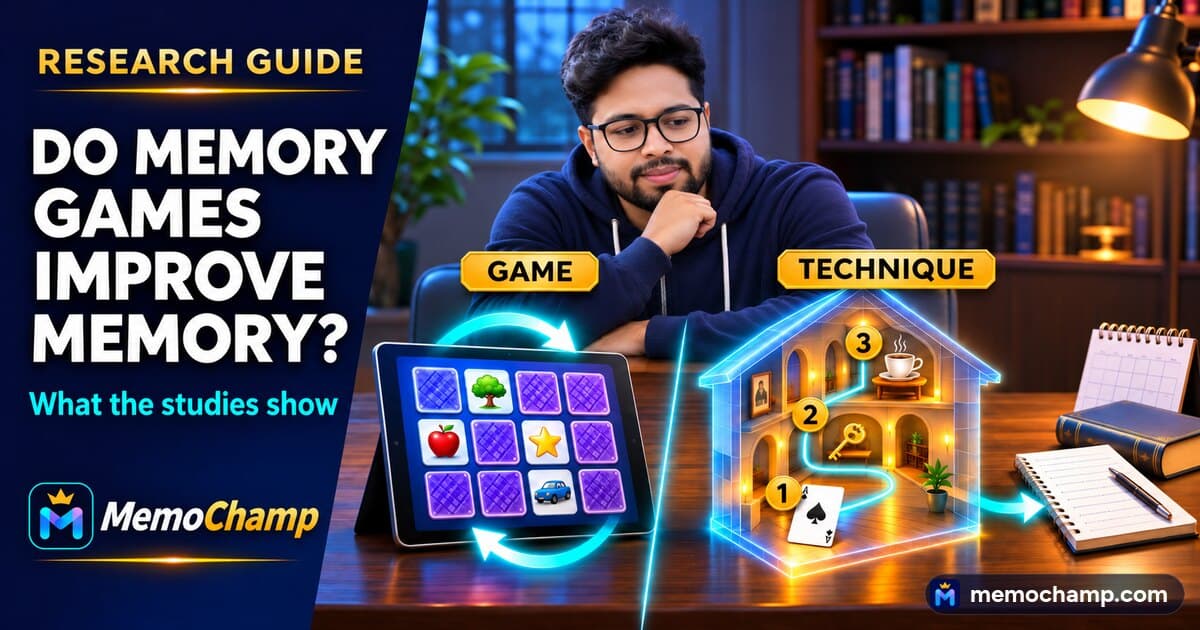
Memory games make you better at the game you play. Large studies find little sign that the gain carries over to everyday memory, school or work. What does improve memory is learning a technique, such as the memory palace, and using it on material you care about. This guide shows the evidence and what to do with it.
Quick Answer
- You get better at the game. Practice improves scores on the tasks you practise.
- The gain rarely spreads. Big studies find little benefit for everyday memory or intelligence.
- Techniques work differently. A method like the memory palace can be used on anything.
- Games are still fine as a hobby, if you do not expect them to fix a memory problem.
What the Big Studies Found
This question has been tested many times, in large studies. The results are consistent, and they are not what the apps' adverts suggest.
More than 11,000 people, six weeks of training
In 2010, researchers working with the BBC programme Bang Goes the Theory asked viewers to train online for six weeks, several times a week. Some trained on memory, attention and maths tasks. Others trained on reasoning and planning. A control group only searched the web for answers to hard questions. Everyone took the same tests before and after. More than 11,000 people finished. The groups that trained improved a lot on the tasks they practised. On the untrained tests, they did no better than the people who had only browsed the web. The authors found "no evidence for any generalized improvements in cognitive function."
A review of the research brain-training companies cite
In 2016, a team of psychologists read the studies cited by brain-training companies to support their claims. They found "extensive evidence" that training improves performance on the trained tasks, less evidence for closely related tasks, and "little evidence" for distantly related tasks and everyday thinking. They also found that none of the studies followed all of the best practices for this type of research.
A review of memory-training research
A 2016 review of working memory training came to the same place. It found reliable improvements on tests close to the training, but no convincing evidence of reliable improvements on measures such as reading, maths and general ability. The authors described the effects as short-term and specific to the training.
The company that had to pay
In January 2016, the US Federal Trade Commission announced that Lumosity's maker would pay $2 million to settle charges over its adverts. The Commission said the company claimed its games could sharpen everyday performance and protect against cognitive decline, but "simply did not have the science to back up its ads."
Why Games Help So Little Outside the Game
When you play a memory game, you learn its rules, its pace and the tricks that suit its layout. You get faster at spotting the pairs, or at holding a short sequence in mind. This is real learning, but it is about that game. Names at a party, a shopping list and a chapter of a book do not look like the game, so none of the tricks apply.
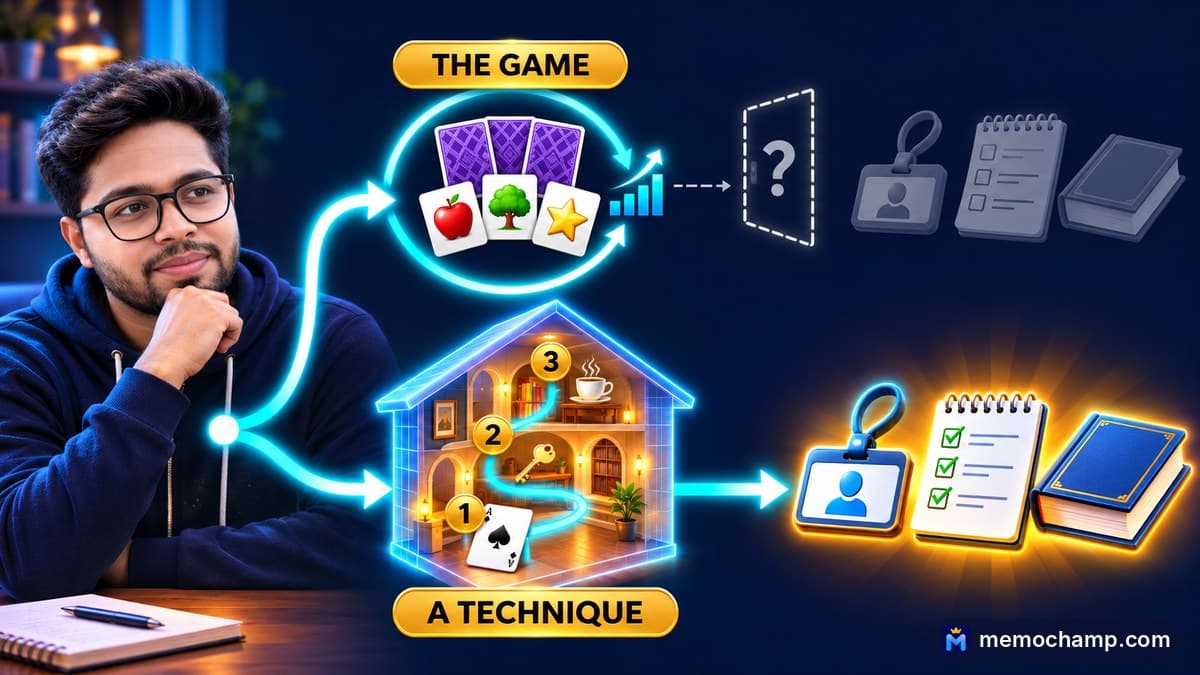
Short-term memory is also very limited. Most people can hold only a handful of new items at once. Games ask you to use that small space better. They do not make the space bigger, and they do not teach you where to put things so that they last.
What Does Improve Memory
The strongest evidence points at something different: learning a method for getting information in, and then practising it.
- A memory technique. In a 2017 study, people with ordinary memories trained in the memory palace method for 30 minutes a day over six weeks. They recalled far more words afterwards, and kept much of the gain four months later. A group trained on a working memory task instead showed no such change. See how memory athletes train and the method of loci guide.
- Recalling instead of re-reading. Testing yourself from memory strengthens what you know more than looking at it again. See active recall.
- Review at growing gaps. Going back to material after a day, then three, then a week keeps it from fading. See spaced repetition.
A technique helps with the kinds of material you apply it to. It does not make you generally smarter. The honest version of the claim is that you get much better at remembering the things you learn to place and picture. There is more on this in does memory training work?
Which Kinds of Memory Game Are Worth Your Time?
| Type | What it does |
|---|---|
| Matching pairs and concentration games | Train the game itself and short-term attention. Good fun and low cost. Do not expect more from them. |
| Brain-training apps | Improve the tasks inside the app. The research does not support claims about school, work or protecting against decline. |
| Memory tests | Measure how you do on one day. They are not training, but they give you a baseline to compare against later. |
| Technique-based practice | Teaches a method (images, a memory palace, a number system) and applies it to long lists. This is the kind with the best support for real gains. |
If you enjoy a game, play it. Just be clear that you are playing for fun. If you want a result you can use, put your minutes into a technique.
Adults, Children and Older People
The findings above come mostly from adults, and the pattern is the same: better at the game, little carry-over. For children, memory games are a pleasant way to practise paying attention, and they do no harm. A simple technique, such as linking a list of words into a short silly story, gives a child something they can use for a spelling list or a set of facts.
For older adults, the picture is more careful. One large trial, ACTIVE, followed about 2,800 older adults for ten years. People who had speed-of-processing training had fewer cases of dementia than the control group. But only about 1,200 people finished the ten years, the result was close to the limit of statistical significance, and the groups that trained memory and reasoning showed no significant benefit. One trial is not enough to say that games prevent dementia.
How to Use Memory Games Well
- Play for fun. If you enjoy it, that is a good reason to play.
- Measure first. Take a free memory test now, and again in a month, so you can see what really changes.
- Learn one technique. Start with memory training for beginners: four weeks, fifteen minutes a day.
- Practise on material that matters. Use the method on lists, names, numbers or the points of a talk, not only on game boards.
- Add review. Recall what you learned a day later, then a few days later.
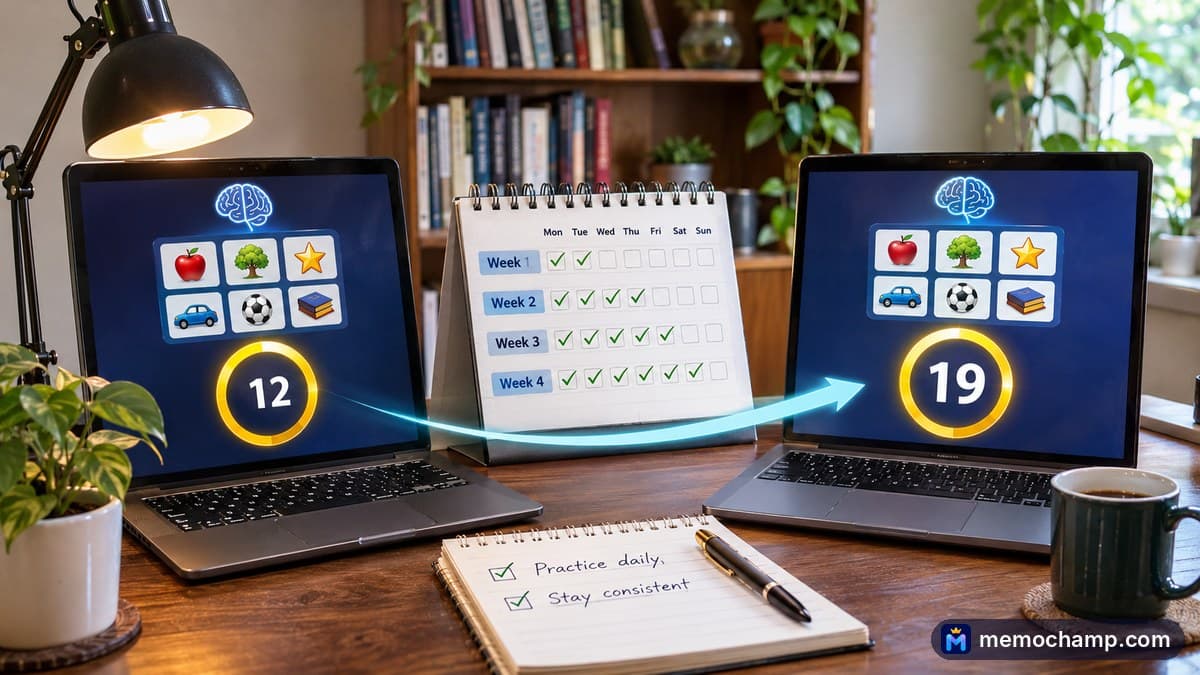
When you want timed practice that rewards a real method, try a championship event such as Random Words or Speed Cards. Every event has a level ladder, so you can start with a short list you can get right every time.
Frequently Asked Questions
Do memory games improve memory?
They improve how well you play the game. Large studies find little sign that this carries over to everyday memory, such as remembering names, appointments or what you read. Learning a memory technique and practising it on real material is the approach with better support.
Can playing memory games improve memory in daily life?
Not reliably. After a review of 132 studies cited by brain-training companies, researchers found extensive evidence of better scores on the trained tasks, but little evidence of better everyday thinking. Games are fine as a hobby; they are a weak way to fix a memory problem.
Are memory games effective for adults?
Adults get better at the specific games they play. Whether that helps with work, study or daily life is the part the evidence does not support. If you want a result you can use, spend your time on a technique such as the memory palace and on spaced review.
Do brain training apps prevent dementia?
There is no good evidence that they do. One large trial of older adults found fewer dementia cases ten years after speed-of-processing training, but the result was borderline, many people dropped out, and the group that trained memory showed no significant benefit. Talk to a doctor if you are worried about memory loss.
Are memory games good for kids?
They are a fun way to practise attention and pairs-matching, and there is no harm in them. Do not expect them to raise school results on their own. Teaching a child a simple technique, such as linking items in a story, gives a result they can use.
What is better than memory games for improving memory?
Learning a method and using it on material that matters to you. In a 2017 study, people trained in the memory palace method for 30 minutes a day over six weeks recalled far more words, and much of the gain lasted four months. Add recall practice and spaced review to keep it.
Are memory championship events the same as brain games?
They look similar, but you train differently. In a memory event you learn a technique, build images and memory palaces, and use them on a long list of cards, digits or words under the clock. The skill is the method, and it works on anything you can turn into images.
Core Takeaways
- Memory games make you better at the game, and the benefit rarely reaches everyday memory.
- Large studies and reviews agree, and a regulator found brain-training claims unsupported.
- A technique such as the memory palace, practised on real material, has much better support.
- Recall practice and spaced review keep what you learn.
- For worries about memory loss, see a doctor rather than an app.
Related Guides
- Memory Training for Beginners — a four-week plan that starts with a baseline test.
- How Memory Athletes Train — the systems and practice behind championship results.
- Photographic Memory — whether it is real, and what champions do instead.
- Memory Techniques — every method, and which to use when.
Sources
Read on 3 November 2026: Owen et al., "Putting brain training to the test," Nature (2010), via Alzforum and the paper; Simons et al., "Do brain-training programs work?", Psychological Science in the Public Interest (2016); Melby-Lervåg, Redick and Hulme, working memory training meta-analysis, Perspectives on Psychological Science (2016); US Federal Trade Commission, Lumosity settlement (5 January 2016); Edwards et al. (2017), the ACTIVE trial and dementia, via ScienceDaily; Dresler et al., "Mnemonic training reshapes brain networks to support superior memory," Neuron (2017).
Get new memory guides by email
New guides and practical memory-training tips, now and then. Unsubscribe at any time.
We'll only use your email for this list. See the privacy policy.